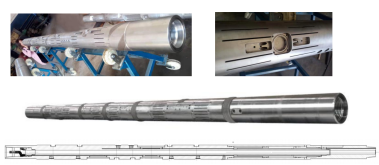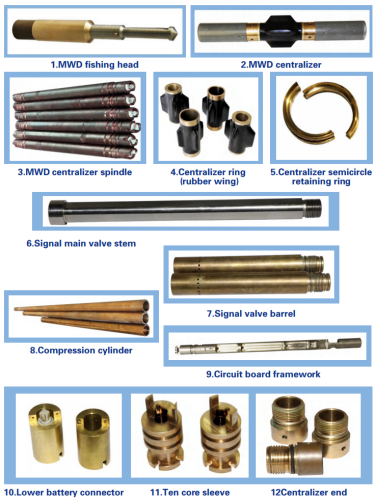



Halliburton-Compatible MWD Accessories: What Matters Most
For many drilling contractors and service companies, the ability to integrate high-quality, third-party accessories with Halliburton-compatible MWD systems is a key operational advantage. However, when choosing these components, “compatibility” must mean more than just fitting the thread—it must mean matching the mechanical and electrical performance of the original equipment. Here is what matters most when selecting Halliburton-compatible MWD accessories.
1. Material Integrity and Metallurgy
The MWD environment is punishing. Accessories such as stabilizers, crossovers, and wear pads must match the metallurgical standards of the primary tool string.
- Non-Magnetic Compliance: For any accessory near the MWD tool’s sensor section, the magnetic permeability ($\mu$) must be strictly controlled ($\mu \leq 1.010$). Choosing sub-standard alloys can lead to “azimuth drift,” creating costly errors in wellbore placement.
- Stress-Corrosion Resistance: Halliburton-compatible components must be manufactured from materials that resist hydrogen embrittlement and stress corrosion cracking (SCC), especially in deep, sour gas (H2S) environments.
2. Dimensional Precision and Interchangeability
The most common point of failure for third-party accessories is dimensional “slop.”
- Tight Tolerances: High-quality compatible parts must adhere to strict API and OEM-equivalent tolerance bands. Even a minor deviation in the shoulder-to-shoulder length of a crossover sub can affect the overall BHA vibration profile or cause electrical contact issues.
- Thread Geometry: Ensuring that threads are machined to exact profiles is non-negotiable. Poor thread fit leads to galling, connection fatigue, and, in the worst cases, a “twist-off” downhole.
3. Electrical and Mechanical Connectivity
MWD tools are complex electronic packages, and their accessories often act as conduits for power and signal.
- Contact Alignment: For battery housings and pulser spacers, internal contact points must be perfectly aligned with Halliburton tool architectures. Any misalignment can cause intermittent power failures (“flickering”) that force a premature trip out of the hole.
- Seal Integrity: All O-ring grooves and seal surfaces must be finished to specific micro-inch standards. Leakage at these interfaces is the fastest way to destroy expensive MWD electronics.
4. The “Rigorous Testing” Benchmark
The best compatible accessories are those that have been subjected to the same validation protocols as the original equipment.
- NDT Certification: Every structural component (stabilizers, collars) should come with full Non-Destructive Testing (NDT) certification, including ultrasonic and magnetic particle inspections.
- 压力测试: Any component that serves as a pressure barrier must be hydrostatically tested to ensure it can withstand the anticipated mud circulation pressures.
5. Conclusion
Choosing Halliburton-compatible MWD accessories is an effective strategy for managing inventory and reducing operational costs—provided that quality is never compromised for price. By focusing on metallurgical standards, dimensional precision, and electrical integrity, you can integrate third-party components into your fleet with confidence, ensuring the same high level of reliability expected from an OEM-only system.