


Navigating the Subsurface: The Role of Directional Probe Sensors in BHA Guidance
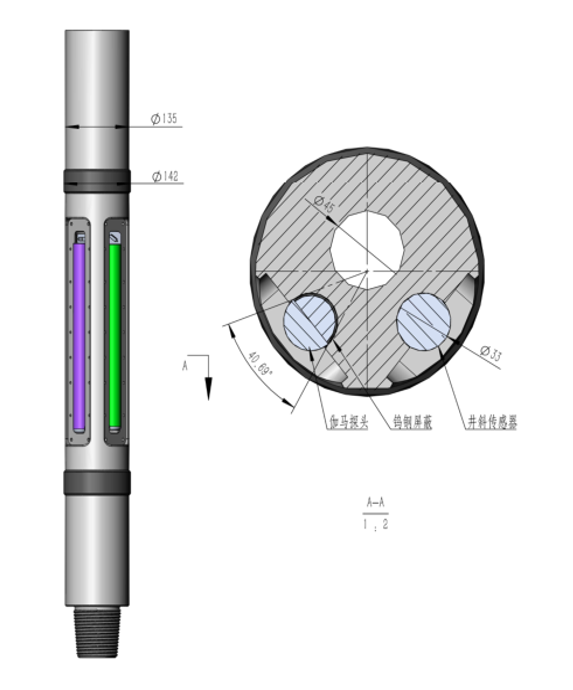
If the MWD pulser is the voice of the drill string, the Directional Probe Sensors are its eyes. Housed securely within the non-magnetic collar of the Bottom Hole Assembly (BHA), these precision instruments measure the Earth’s magnetic and gravitational fields to determine the exact position, inclination, and azimuth of the wellbore in real time.
1. How Directional Probes Work
At the core of every directional probe are two primary sensor types working in tandem:
- Accelerometers (Gravity Measurement): These sensors measure the pull of gravity along three orthogonal axes. By analyzing the gravitational vector, the system calculates the exact inclination (the angle of the wellbore relative to vertical) and the tool face orientation.
- Magnetometers (Magnetic Field Measurement): These measure the intensity and direction of the Earth’s magnetic field. Combined with accelerometer data, they calculate the azimuth (the compass heading or horizontal direction of the wellbore).
2. Key Operational Advantages
- Absolute Trajectory Control: In complex directional and horizontal drilling, these sensors ensure the BHA stays precisely inside the target reservoir, preventing costly sidetracks or collision risks in crowded offshore fields.
- High-Accuracy Surveying: Modern solid-state directional probes provide high-precision continuous surveys, reducing uncertainty and ensuring compliance with strict wellbore placement regulations.
- Durability Under Extreme Shock: Because they are located just feet behind the bit, these probes are subjected to intense mechanical shocks and vibrations. Advanced thermal shielding and shock-mounting ensure continuous operation in high-temperature environments.
3. Engineering for Harsh Downhole Physics
- Rigorous Calibration: Directional sensors undergo multi-axis calibration at varying temperature extremes to eliminate bias and sensor drift, ensuring consistent accuracy downhole.
- Non-Magnetic Environment: To prevent magnetic interference from the steel drill string, these probes must be run inside specialized non-magnetic drill collars (Monel or copper-beryllium), allowing the magnetometers to read the true Earth field accurately.
4. Conclusion
Directional probe sensors are the foundational navigation instruments of modern drilling. By converting invisible physical forces—gravity and magnetism—into actionable trajectory data, they empower drillers to steer complex wells with unprecedented accuracy.